Posts

Showing posts with the label 135mm

Pentacon Auto 135mm f2.8 vintage lens review

Image
In my opinion, the Pentacon 50mm 1.8 is one of the most versatile vintage lenses and one of my favorites. I’ve shot multiple rolls of film on it and used it countless times on digital and because of it I’ve been curious to try more lenses from the brand. Unfortunately, the 29mm didn't hold up to 50 and the 135 kept eluding me; until now. There are three versions of this lens that I know of: the first and most sought after has fifteen blades in the iris and it is a copy of the Meyer-Optik Görlitz Orestor. The second version is the one we're testing today and the third is the Praktica version with a Praktica mount. So let's take a closer look. The lens is made of metal, it weighs around 460g, it is 89 to 101mm long and it has an external diameter of 65mm, with a 55mm front thread. It has a built-in sunhood. The iris has 6 blades, the aperture is clicked and it goes from f2.8 to f22 with half steps. It has an auto/manual switch near the bottom. The focusing ring is textured, i...

Canon FL 135mm f3.5 vintage lens review

Image
  In recent years, Canon FD lenses have regained popularity thanks to people on the internet praising them and eventually leading to prices rising like a cake in the oven. What most people don’t know is that before FDs, specifically from 1964 to 71, Canon made FL lenses and they can be found for cheaper, b ut are they any good? Well, today we’re taking a look at the Canon FL 135mm f3.5 The lens is made of metal, it weights around 420g, it is 86 to 101mm long and it has an external diameter of 61mm, with a 47mm front thread. The iris has 8 blades, the aperture is clicked and it goes from f3.5 to f22   without half steps and near the mount there is an auto/manual selector. The focusing is rubberized, it turns 220 degrees and minimum focusing distance is a 1.5m. The Canon FL mount is the same as the FD, with a flange distance of 42mm. The aperture ring is narrow, but having   a grippy texture and being on the front of the lens, just before the nose gets smaller, ...

Canon FD 135mm f3.5 - vintage lens review

Image
By now, you probably know that 1: Canon FDs are some of my favorite vintage lenses and 2: 135mm is one of my favorite focal lengths So when I saw this guy, in perfect conditions and for an honest price, I just had to buy it.  Needless to say, I’m not disappointed. Quick history refresher: the Canon FD mount was introduced in 1971 and updated to the nFD, or new FD, in 1976 and then replaced by the EF mount in 1987. Today’s lens is from the nFD era. The Canon is made out of metal and hard plastic, it weights 300g, it is 87mm long when focused to infinity and 105mm when fully extended, with a 52mm front thread. It has a built-in sunhood, lined with an opaque material to avoid reflections. The iris has 6 blades, the aperture is clicked and it goes from f3.5 to f32 with half steps, plus auto. The focusing ring is textured and it turns 230 degrees and minimum focusing distance is 1.3m. Flange distance for the Canon FD mount is 42mm, easy to adapt to mirroless cameras . ...

Takumar bayonet 135mm f2.5 - vintage lens review and test

Image
Takumar lenses are well known and praised for their quality in the vintage lenses community, to the point that they have achieved almost an iconic status and prices in recent years have risen like a cake in the oven. But not all Takumar were created equal; somewhere in between the 80s and 90s, Asahi Optical produced a sort of obscure line under the name Takumar Bayonet and the lens we’re talking about today is one of those. Unlike previous lines with the same name, these more recent lenses lack the Super-Multi-Coating, have bayonet mounts, from which their name, and they look just like the Pentax-M series. Allegedly, they were intended as a budget option, so let’s take a closer look and see for ourselves. The Takumar is made out of metal, it weights around 390g, it is 78mm long when focused to infinity and 97mm when fully extended, with a 52mm front thread. It also has a built-in sunhood. The iris has 8 blades, the aperture is clicked and it goes from f2.5 to f22 with half steps. The f...

Avanar/Chinon 135mm f2.8 - vintage lens review

Image
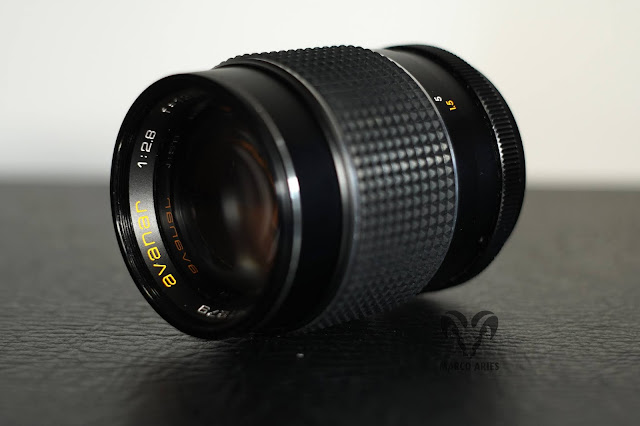
Those of you who follow me on Instagram  might remember that a couple months ago I bought a box of... stuff, and one of the items inside was this Avanar 135mm. There is no information on the internet about this brand, although some people speculate is was a European rebrand for Chinon, a Japanes manufacturer founded in 1962 and later acquired by Kodak, and, in fact, the Chinon 135mm f2.8 looks identical to the Avanar If by any chance you happen to know anything mote about the brand Avanar, feel free to share your knowledge in the comments; meanwhile, let us take a closer look. The body is made ot metal and it weighs 400g, it is 87mm long when focused to infinity and 101mm when extended, with a 55mm front thread. Plus, as many vintage 135s, it has a built in sun hood. The iris has 6 blades, the aperture is clicked and it goes from f2.8 to f22, with a switch for automatic and manual aperture. The focusing ring has a nice rubberized grippy texture and it turns roughly 240°, minimum ...

Konica Hexanon AR 135mm f2.5 - lens review

Image
  Since my review of the 40mm f1.8 everyone has been telling me to check out the 135mm, but as I soon found out, there are multiple versions of it and the general consent seems to be that the f3.5 version is the one to get, sharper, lighter, more compact and so on. Obviously, the only one I could find was the f2.5, but I got it anyway. Since I bought it, I've found myself coming back to it time and time again, it's a lens that keeps giving, I really enjoy shooting it and, as you probably all know by now, I prefer longer lenses to short and wide ones, and this one really reminds me of my Tokina 135mm f2.8, they are really similar although this is a bit bigger, but we will discuss more about that in a dedicated video, if you want to.  Anyway, this “big boi”, as I like to call it, has a metal body and weighs around 650 grams. It is 93mm long when focused to infinity, 118mm when extended and when you pop out the built-in sun hood it gets to 134mm; the front thread has a 62mm dia...

Yashica 135mm f2.8 ML - Lens review

Image
  Last winter I bought three Yashica lenses and a camera body fo quite cheap, because they were not in the best conditions, especially the 135mm.  The optical elements were dirty, the aperture had been poorly de-clicked and, worst of all, the focusing helicoid was completely off and needed to be recalibrated and lubricated, so I gave it to a lab to be fixed and cleaned and now it works perfectly.  Yashica is one of those well know names in the industry, with a history dating back to the late '40s and in 1975 they introduced the Contax Yashica bayonet mount in collaboration with Carl Zeiss. They had three ranges of lenses: the basic one was the DSB, which had single coatings, above that was the ML, with multi coatings, and the top of the line was the Zeiss AE series.  Now, back to this lens.  The body is made of metal and weights 410 grams; it is 76mm long when focused to infinity and 90mm when fully extended, with a 52mm front thread and, my favorite featur...

Tokina RMC 135mm f2.8 - lens review

Image
  Let's be honest: there are a few reasons why I bought this lens and the most important one is the built-in sun hood.  Jokes aside it was on sale for 20 euros, it's a small, compact, rugged 135mm f2.8 so I just said “heck, I'll get it” and I must say that I'm not disappointed. This really is a rugged, compact, easy to carry telephoto lens and that 2.8 aperture is not that easily found is this focal length on older vintage lenses, as many of them are f3.5 or even f4. Tokina RMC 135mm f2.8  Talking about size, it is 82mm long when focused to infinity, 96mm when fully extended, 114mm when the sun hood is out, with a 52mm front thread and it weights 400 grams.  The body is made of metal, with a rubberized focus grip, the iris has 6 rounded blades, the aperture is clicked and goes from f2.8 to f16, past which there’s a red EE markers, for the auto exposure feature that works on compatible analog cameras.  It comes in different mount, mine has a Konica AR mount...