Posts

Showing posts with the label review

Yashica 28mm f2.8 - lens review

Image
  Last winter I bought three Yashica lenses and this 28mm is one of them, along the 135 and the 50mm; it’ the most “humble” of the trio, being part of the basic, single coated DSB line. Yet, it doesn’t fall behind it’s sisters, in fact I would say it is better than the 135mm.  The body is made of metal and it weighs 220 grams, it is 40mm long when focused to infinity and 44mm when fully extended, with a 52 mm front thread. The iris has 6 blades, the aperture is clicked and it goes from f2.8 to f16. The focusing ring is textured, it turns 180 degrees and minimum focusing distance is 30 centimeters. Contax Yashica mount flange distance is 45,5mm and adapters are easy to find.  Sharpness is good wide open and it gets even better by stopping down a bit. Same goes for edge falloff. Background blur is not the softest, but it is not distracting either.  Chromatic aberration did show up in some really high contrast areas, but I only noticed it because I was activel...

Neewer 32mm f1.6 - lens review

Image
 My first fast prime was the Fujian 35mm f1.7, a lens made for security cameras with a quite unique look, and today we are trying out another small and cheap lens but, this time, specifically made for APS-C cameras.  The lens comes in a nice and padded black box that contains the lens itself, obviously, a pouch, a microfiber cloth and some documentation.  The body is made of metal and only weights 165 grams; it is 59mm long when fully extended with a 49mm front thread. It has 6 optical elements ins 4 groups.  The iris has 12 blades, the aperture is stepless and very smooth, with an nice resistance so you won’t accidentally move it, and it goes from f1.6 to f22.  The focusing ring turns 180° and minimum focusing distance is 25 centimeters.  Not needing and adapter is a nice change of pace for me, and the combination of this small and lightweight lens and my Sony APS-C camera bodies makes for a really compact and nimble setup.  There are two reasons that...

Konica Hexanon AR 50mm f1.7 - lens review

Image
  If you've been around my channel or this blog for a while you'll probably know that I've been building a kit of Konica Hexanon lenses, more by chance than by choice, let's be honest. Yet I now find myself owning the well-known 40mm f1.8 “pancake”, the 135mm f2.5 “big boi” and the 50mm f1.7, along with two third-party lenses, the Tokina 135mm f2.8 and the Sigma 35-70mm. Konica Hexanon AR 50mm f1.7  I bought this lens at the end of last summer from a kind old man, a retired semi-professional photographer, so it was well kept and maintained, clean lenses and no mechanical issues.  The body of the lens is made of metal and weights 210 grams; it is 40mm long when focused to infinity and 47mm when fully extended. The focusing ring is rubberized with a nice grippy texture and it turns 180 degrees. Minimum focusing distance is average at 55cm, the iris has six blades, the aperture is clicked and goes from f1.7 to f16. Past that it goes into auto exposure mode and you have t...

Konica Hexanon AR 135mm f2.5 - lens review

Image
  Since my review of the 40mm f1.8 everyone has been telling me to check out the 135mm, but as I soon found out, there are multiple versions of it and the general consent seems to be that the f3.5 version is the one to get, sharper, lighter, more compact and so on. Obviously, the only one I could find was the f2.5, but I got it anyway. Since I bought it, I've found myself coming back to it time and time again, it's a lens that keeps giving, I really enjoy shooting it and, as you probably all know by now, I prefer longer lenses to short and wide ones, and this one really reminds me of my Tokina 135mm f2.8, they are really similar although this is a bit bigger, but we will discuss more about that in a dedicated video, if you want to.  Anyway, this “big boi”, as I like to call it, has a metal body and weighs around 650 grams. It is 93mm long when focused to infinity, 118mm when extended and when you pop out the built-in sun hood it gets to 134mm; the front thread has a 62mm dia...

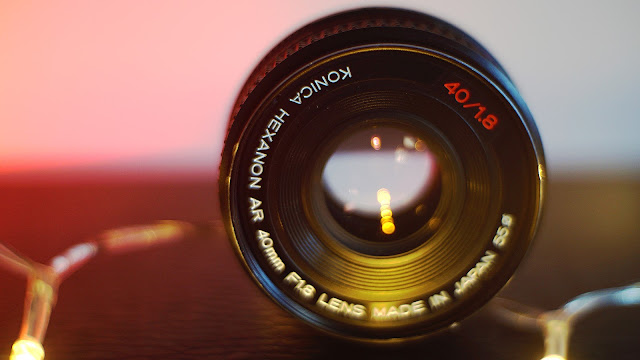
Konica Hexanon AR 40mm f1.8 - lens review

Image
  There’s a bit of a story behind acquiring this lens. In the summer of 2019 I went to a different flea market, one I had never been before and on a table I saw a camera and a couple lenses. I quickly inspected them and while they seemed in great conditions, but I barely knew the Konica name and had no knowledge on how good, or bad, it could be, so I left it there. Considering that I usually buy almost anything, it was pretty uncharacteristic of me. By the time I got home I was still thinking about that lens, so I looked it up on the internet and realized that at least the 40mm was supposed to be a good lens, and the price was fair too. “Well”, I said to myself, “you lose one, you get one, I’ll find something else next time”. A month later I went back to that flea market and, lo and behold, there it was, still waiting for me, so I bought it, along with some paperwork, a small catalog, the Kenlock 100-300mm, an Autoreflex TC camera, which I will eventually try, and a focal multiplie...

Mir 1b 37mm f2.8 - lens review

Image
  After I got into vintage lenses in 2017, I started looking for some Soviet ones, to see for myself if the hype was real, but for a good couple years I could never find one in good conditions or for a good price, until the day I stumbled into a mint Mir 1b. It's a pretty well-known lens, one of those everyone on the internet recommends, so I was quite interested in trying it out.  It’s a fairly small lens, 52mm long with internal focusing and a 49mm front thread, but it has a nice heft with its 200 grams of weight due to the all-metal body.  The focusing ring has a nice gruppy shape and it turns 270 degrees, but minimum focusing distance is a massive 70cm; some people disassemble the lens to remove the screw that stops the ring from turning all the way and achieve a shorter minimum distance, but I still haven’t tried doing it myself.  The iris had ten blades and the aperture is… confusing. To be honest, when I recorded the video review I still couldn’t wrap my...

Industar 50-2 - lens review

Image
  The Industar 50-2 it's a very, very small lens made for SLRs and rangefinder cameras starting from 1959. Is has a screw mount, either M39 or, as mine, M42 and a stepless aperture, which is kind of interesting.  Although the name is 50-2 it's not a 50 millimeters f/2, it's actually at its widest an f3.5, which means it's not the brightest lens.  The construction is quite simple, I took it apart to clean it and, well, I had no problems doing so. I actually had to clean because it needed to be lubricated a little bit, but since I have put some oil in it, it works just fine.  The metal body houses three optical elements, it weights only around 80 grams, it is 19mm long when focused to infinity and 25mm when extended with a 34mm front thread. Aperture, as said, is stepless, with seven blades and goes from f3.5 to f16. The focusing ring rotates more or less 310 degrees, which usually means that it is easy and precise to focus, but this lens is not sharp so it ...

Pentacon 50mm f1.8 - Lens review

Image
  The Pentacon 50mm was mass produced and it was sold as a standard lens on Praktica and Pentacon cameras, usually with an m42 mount; they are usually pretty easy to come around and cheap to buy. Yet, this is the only one I’ve found so far, here in Italy.  As we saw with the Petri 55mm, just because a lens came as a standard kit, it doesn't mean it is bad. In fact, the Pentacon is really, really good and for me it was love at first shot.  Let's be honest, I haven't done much research this time, I more or less know the brand, I like the lens and it was fine for me, so I didn't need to dive deep into researching. Plus the good old Mark Holtze has already published a very in-depth, and as always very well done, video so check it out.  What I did found is that the one that I got, the version with the double chrome rings and the stripes all around, should be the earliest version, the one closer to the original Meyer Gorlitz Optics design.  Now, the lens itself ...

Yashica 135mm f2.8 ML - Lens review

Image
  Last winter I bought three Yashica lenses and a camera body fo quite cheap, because they were not in the best conditions, especially the 135mm.  The optical elements were dirty, the aperture had been poorly de-clicked and, worst of all, the focusing helicoid was completely off and needed to be recalibrated and lubricated, so I gave it to a lab to be fixed and cleaned and now it works perfectly.  Yashica is one of those well know names in the industry, with a history dating back to the late '40s and in 1975 they introduced the Contax Yashica bayonet mount in collaboration with Carl Zeiss. They had three ranges of lenses: the basic one was the DSB, which had single coatings, above that was the ML, with multi coatings, and the top of the line was the Zeiss AE series.  Now, back to this lens.  The body is made of metal and weights 410 grams; it is 76mm long when focused to infinity and 90mm when fully extended, with a 52mm front thread and, my favorite featur...

Kenlock mc tor 100-300 5.6

Image
 Many vintage lenses are known to be small, compact and fairly lightweight, but this one is not. More than 19 centimeters long with the sun hood collapsed and 700 grams of weight it's kind of a beast.  I bought this lens along with the Konica Autoreflex TC and the Konica Hexanon 40mm f1.8, and my first question was: “how the heck did they do this? How the heck did they use such long, heavy lens on an analog film camera?”  I mean, even with the in-body stabilization of my Sony a6500 I had a really hard time using this lens, getting stable footage and avoiding shaky pictures, especially at 300 millimeters, partially obviously because of the focal length, but also because this lens is fricking heavy and makes the system really front heavy. Plus the adapter can't really hold that much weight so it flexes a little bit. Yeah, that was kind of weird, I seriously feared for my camera while using this lens, so much so that I always hold the system by the lens and not by the ca...

Asahi Pentax M 50mm f1.7 SMC - lens review

Image
  When I found this lens at the usual flea market, where I’ve found a number of my vintage lenses, I bought it immediately, partially because of Mark Holtze’s amazing videos about the Super Takumars, but also because I’ve been actually looking for some Pentax lenses for a couple years, after I missed a good deal at the same flea market.   This lens is very compact, almost pancake size, being only 32mm long when collapsed and 40mm when extended it is quite smaller than similar lenses from other brands, like the Konica Hexanon 50mm 1.7, the Canon FD 50mm 1.8 and the Yashica ML 50mm f1.7; only the well known Konica Hexanon 40mm 1.8 is a bit shorter.  The body is made of both metal and plastic, keeping down the weight to around 190 grams. Even the front thread is smaller, with a 49mm diameter, surrounding the beautiful Super Multi Coated front element.  The iris has six blades, the aperture is clicked and goes from f1.7 to f22. The focusing ring has a rubbe...

Konica C35 - Shooting my father's old camera

Image
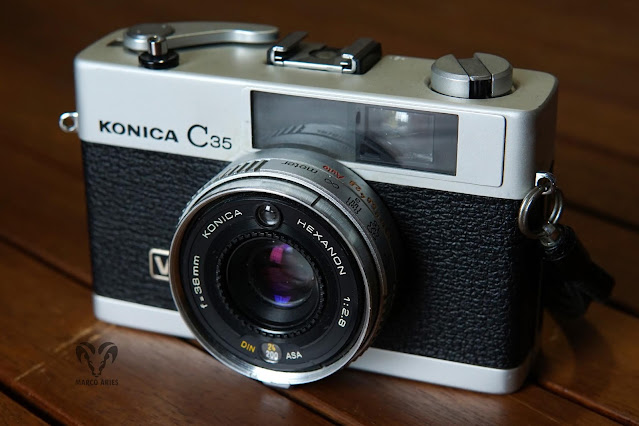
  Something you don’t know about me is that I got my start in photography when I was a kid with a cheap plastic point-and-shoot camera, a bright red Konica POP super, and it's been somewhere around 15 years since the last time I shot film and I was feeling the itch to get back to it. So I did.   A couple of years ago my father dug out his old camera, a Konica C35, and gave it to me, as it hasn't been used in like 20 or 30 years, something like that. He got it in the 70s and brought it with him in his most exciting travels, Paris and New York, and used it to document his life time and time again.  So I bought a couple rolls of film, Kodak color plus 200, the most basic film you can get, and started shooting. Too bad it took me more than a year to shoot 24 exposures, but eventually I managed to get through the roll get it developed. Then I had to scan it because, surprisingly, it costs way too much to digitalize pictures, it was way cheaper to just buy a scanner, a basic ...

Tokina RMC 135mm f2.8 - lens review

Image
  Let's be honest: there are a few reasons why I bought this lens and the most important one is the built-in sun hood.  Jokes aside it was on sale for 20 euros, it's a small, compact, rugged 135mm f2.8 so I just said “heck, I'll get it” and I must say that I'm not disappointed. This really is a rugged, compact, easy to carry telephoto lens and that 2.8 aperture is not that easily found is this focal length on older vintage lenses, as many of them are f3.5 or even f4. Tokina RMC 135mm f2.8  Talking about size, it is 82mm long when focused to infinity, 96mm when fully extended, 114mm when the sun hood is out, with a 52mm front thread and it weights 400 grams.  The body is made of metal, with a rubberized focus grip, the iris has 6 rounded blades, the aperture is clicked and goes from f2.8 to f16, past which there’s a red EE markers, for the auto exposure feature that works on compatible analog cameras.  It comes in different mount, mine has a Konica AR mount...

Sony 18-105 f4 G OSS - The workhorse - lens review

Image
  The Sony 18-105 constant f4 is an optically stabilized lens from the G series for E mount cameras, specifically for the APS-C sensors cameras such as the a5100 and the 6000 series.  Theoretically this is a great all-around lens, going from wide to telephoto while keeping that f/4 aperture constant. Plus, the barrel does not extend when zooming and that makes for a great lens to be used on electronic gimbals and other stabilizers.  It is also fairly compact and lightweight, even if it has power zoom built-in and optical stabilization, being 11.5cm long with a 72mm front element and 427 grams of weight.  Zoom and focus are electronic, so they don’t have hard stops, and the motors are extremely quiet.  I bought this lens at the beginning of 2018 and before reviewing it I used it in many different situations: I used it both for taking pictures and videos, as I always do, I took portraits, shot concerts, brought it with me to the other side of the world and...

Canon FD 24mm f2.5 - Lens review

Image
 The Canon FD 24mm f2.8 was the other lens I borrowed from a friend in 2018, along with the 100mm 2.8, when I was first getting into vintage lenses. Yes, I know, I was a little spoiled.  Anyway, I've never been much into wider focal lengths, you know, 21, 24, 28mm and such, even if I'm often around there when using zoom lenses. I don't know, maybe it's because I shoot portraits a lot, so I tend to gravitate towards longer lenses.  Using this lens made me realize that wider lenses are not bad at all, especially opening up to that f2.8 and getting smoother backgrounds and isolating the subject, while incorporating more of the surroundings.  Even if everyone is constantly talking about Canon FDs, I was still a little bit surprised because the quality you get from this lens it's really something, especially if you consider the difference in price between a lens like this and a modern one with the same specs.  As most vintage lenses, it is a little bit soft wide open...

Canon FD 100mm f2.8 - Lens review

Image
 Canon FD lenses have grown in popularity in the last few years because they're cheap, easy to find, reliable and with cheap adapters you can mount them to modern digital cameras. Mirrorless like Sony's or Canon's EOS R and RF will work best and will be easier to adapt, but you can use Canon FD lenses on your DSLRs too, although you might need a different adapter with a focal reducer, due to the incompatible flange distance. Personally, I'm not a fan of focal reducers, as they cad degrade or alter the quality of the image produced by the lens.  Anyway, these Canon FD lenses are completely manual and have no electronic, and this one specifically is part of the so-called nFD, or new FD, series, introduced in 1979.  Everyone seems to love them so, back in 2017 when I was getting into vintage lenses, I was eager to try them. Luckily, a friend of mine owned two of them and he was kind enough to let me borrow them for a few weeks.  Right off the bat this lens sounds p...

Petri 55mm f1.8 - That old brand you might not know about - Lens review

Image
 At the end of 2019 I was at this event where they sell a bunch of old cameras and lenses and  obviously I bought a few, but among the various items on display for the first time I saw many lenses and cameras branded Petri.  Initially I thought it was some obscure Italian brand but, as one of the vendors explained to me, it's actually Japanese. I did a little bit of research and turns out it was established in 1907, so it's pretty damn old, but eventually went bankrupt in the 80s and the brand was acquired by Cosina, which is slightly more known in the vintage community  So I browsed a little bit the selection of cameras and lenses they had and eventually decided to buy this 55 millimeters f1.8 mostly because I didn't know the brand, it was cheap and this specific one comes with an M42 mount instead of the Petri mount, which I guess no one makes an adapter for.  And, yeah, you might be starting to see a pattern here: I have quite the habit of buying l...

Enna München Tele-Ennalyt 240mm f4.5 - A rare German lens? - Lens review

Image
As my regular followers will know, I take my time to review a lens, using it in different situations and environments and getting familiar with it, and that usually means one or two months, up to one or two years, at times. Yet, for this lens it only took me a few days and not because I'm getting better at it. I had never heard about this brand before and there is not much information about it on the internet, but in summary Enna was a small German manufacturer active from 1920 to 1992, making lenses both under their own name and for other brands like Porst. Apparently they also made a couple of interesting things like the world's fastest 35mm in 1958 and the first German designed tele zoom in 1961. The body is made of metal and weighs 300 grams. It is 13cm long when focused to infinity and 15,4cm when fully extended. When focusing the whole barrel turns 360 degrees, meaning that the 52mm front element turns as well. Minimum focusing distance is somewhere between 2.8 and 3 mete...