Posts

Jupiter 21M 200mm f4 - vintage lens review

Image
  When it comes to vintage soviet lenses many will tell you that you must get the Mir 1B, the Helios 44 and the Jupiter 9 to have the perfect kit; some would add the Tair 11 to the list. Yet, there are many more interesting lenses that end up being left out of the conversation and the Jupiter 21 is one of them. Not long ago I found this beast of a lens at a local flea market, and I was surprised to find out that the owner manual and warranty is still mostly intact. I asked my Russian friend Masha to help me out translating part of it and we discovered that this lens came out of the Vologda Optical and Mechanical Plant, or VOMZ, in June 1993. VOMZ was founded in the city of Vologda in 1971 and between 1977 and 1986 was part of LOMO. The factory is still active to this day, producing thermal imaging cameras. Coincidentally, my Mir 1B comes from the same factory. Jupiter 21M 200mm f4   The Jupiter is big. It weighs 980g, it is 15,5cm long when focused to infinity and 18...
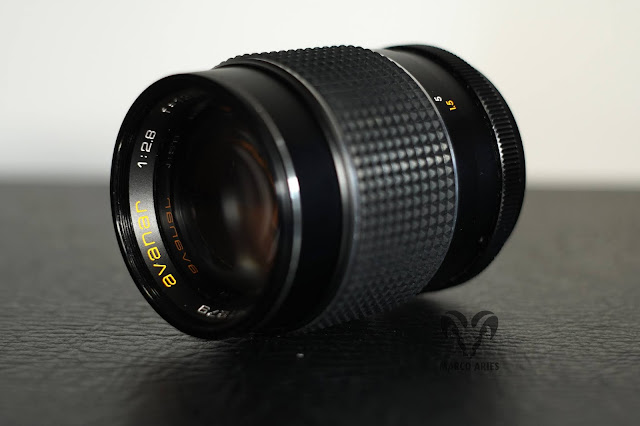
Avanar/Chinon 135mm f2.8 - vintage lens review

Image
Those of you who follow me on Instagram  might remember that a couple months ago I bought a box of... stuff, and one of the items inside was this Avanar 135mm. There is no information on the internet about this brand, although some people speculate is was a European rebrand for Chinon, a Japanes manufacturer founded in 1962 and later acquired by Kodak, and, in fact, the Chinon 135mm f2.8 looks identical to the Avanar If by any chance you happen to know anything mote about the brand Avanar, feel free to share your knowledge in the comments; meanwhile, let us take a closer look. The body is made ot metal and it weighs 400g, it is 87mm long when focused to infinity and 101mm when extended, with a 55mm front thread. Plus, as many vintage 135s, it has a built in sun hood. The iris has 6 blades, the aperture is clicked and it goes from f2.8 to f22, with a switch for automatic and manual aperture. The focusing ring has a nice rubberized grippy texture and it turns roughly 240°, minimum ...

Yashica 50mm f1.7 ML - lens review

Image
We made it to the last of the three Yashica lenses I bought last winter: the 50mm f1.7 ML. If you want to check out the reviews for the 28mm  and the 135mm you can find them here on the blog and on my channel . I gotta say: it is no that easy to review 50mm lenses, because there are so many of them and most are just as good as the next one, with only a few really standing out and the Yashica is, well, one in the bunch. The body is made of metal and it weighs 220 grams, it is 40mm long when focused to infinity and 48mm when extended, with a 52mm front thread. The iris has 6 blades, the aperture is clicked and it goes from f1.7 to f16. The focusing ring turns 180 degrees and minimum focusing distance is 50 centimeters. Contax Yashica flange distance is 45,5mm and adapters are easy to find In terms of size, weight and build, the 50mm is basically identical to the 28mm 2.8 that I have already shown you, minus some aesthetic differences and the different coating, being single on the...

Yashica 28mm f2.8 - lens review

Image
  Last winter I bought three Yashica lenses and this 28mm is one of them, along the 135 and the 50mm; it’ the most “humble” of the trio, being part of the basic, single coated DSB line. Yet, it doesn’t fall behind it’s sisters, in fact I would say it is better than the 135mm.  The body is made of metal and it weighs 220 grams, it is 40mm long when focused to infinity and 44mm when fully extended, with a 52 mm front thread. The iris has 6 blades, the aperture is clicked and it goes from f2.8 to f16. The focusing ring is textured, it turns 180 degrees and minimum focusing distance is 30 centimeters. Contax Yashica mount flange distance is 45,5mm and adapters are easy to find.  Sharpness is good wide open and it gets even better by stopping down a bit. Same goes for edge falloff. Background blur is not the softest, but it is not distracting either.  Chromatic aberration did show up in some really high contrast areas, but I only noticed it because I was activel...

Neewer 32mm f1.6 - lens review

Image
 My first fast prime was the Fujian 35mm f1.7, a lens made for security cameras with a quite unique look, and today we are trying out another small and cheap lens but, this time, specifically made for APS-C cameras.  The lens comes in a nice and padded black box that contains the lens itself, obviously, a pouch, a microfiber cloth and some documentation.  The body is made of metal and only weights 165 grams; it is 59mm long when fully extended with a 49mm front thread. It has 6 optical elements ins 4 groups.  The iris has 12 blades, the aperture is stepless and very smooth, with an nice resistance so you won’t accidentally move it, and it goes from f1.6 to f22.  The focusing ring turns 180° and minimum focusing distance is 25 centimeters.  Not needing and adapter is a nice change of pace for me, and the combination of this small and lightweight lens and my Sony APS-C camera bodies makes for a really compact and nimble setup.  There are two reasons that...

A box full of stuff

Image
  We all spend too much time browsing for good deals on vintage lenses, hoping to find that one rare piece of glass in mint conditions on sale for peanuts and finally be the one who can brag about it on social media. Well, this week happened to me. Sort of.  I was, as said, browsing local ads when I spotted someone selling a Zenit B and a Helios 44m-4 for 20 euros. “Decent deal”, I thought, “I could probably flip it for a bit of profit”. The seller was just 20 minutes away by car, so I reached out to him, knowing that probably the items had already been sold, especially considering that there where pictures of at least three more lenses coming for free with the camera. A few hours passed and the seller responded and we agreed on meeting the day after. I was fairly sure that they either typed 20 instead of 200, or that every lens was broken.  You can understand my surprise when I finally saw the box and started sorting through and found out that, while a bit dinged and...

Konica Hexanon AR 50mm f1.7 - lens review

Image
  If you've been around my channel or this blog for a while you'll probably know that I've been building a kit of Konica Hexanon lenses, more by chance than by choice, let's be honest. Yet I now find myself owning the well-known 40mm f1.8 “pancake”, the 135mm f2.5 “big boi” and the 50mm f1.7, along with two third-party lenses, the Tokina 135mm f2.8 and the Sigma 35-70mm. Konica Hexanon AR 50mm f1.7  I bought this lens at the end of last summer from a kind old man, a retired semi-professional photographer, so it was well kept and maintained, clean lenses and no mechanical issues.  The body of the lens is made of metal and weights 210 grams; it is 40mm long when focused to infinity and 47mm when fully extended. The focusing ring is rubberized with a nice grippy texture and it turns 180 degrees. Minimum focusing distance is average at 55cm, the iris has six blades, the aperture is clicked and goes from f1.7 to f16. Past that it goes into auto exposure mode and you have t...